The UK government’s 10-Year Health Plan for England positions AI as a core component of health system reform, while the Neighbourhood Health Guidelines (2025–26) emphasise data, interoperability, and a shift toward community-centred services.
Together, these strategies reflect a decisive shift. AI is no longer an experimental add-on in the NHS or an isolated pilot. It is becoming embedded as a strategic enabler of clinical, operational, and population health transformation.
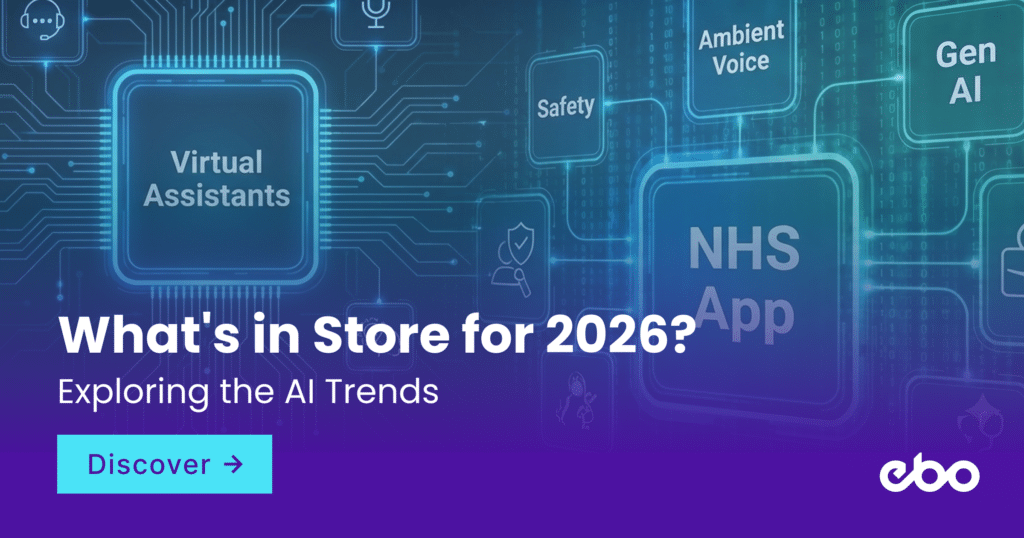
As the new year begins, we explore the key AI trends shaping the NHS in 2026 – what lies ahead and what healthcare leaders should be paying attention to.
1. Virtual Assistants Mature as “digital team-mates”, not replacements
In 2026, conversational AI–powered virtual assistants will be judged less on how sophisticated they sound and more on how effectively they support patients and relieve administrative pressure on staff. When implemented well, these assistants function as reliable digital team-mates—handling routine interactions while ensuring patients can quickly access a human when needed.
For the NHS, this translates into fewer inbound calls for basic requests, reduced strain on reception and administrative teams, and more consistent management of high-volume patient enquiries. For patients, it means quicker responses, simpler appointment management, and fewer frustrating dead ends.
Crucially, AI is designed to complement, not replace, human care, freeing staff to focus on complex, sensitive, and time-critical cases where their expertise matters most.
2. Ambient voice and AI documentation become mainstream - with proper governance
Ambient scribing and voice tools will become part of everyday clinical work, allowing clinicians to spend less time typing and more time listening. “Voice‑activated and ambient systems” (commonly known as AI scribes) that listen during patient interactions and generate structured documentation are gaining traction as workflow aids – becoming a normal part of clinical practice” says EBO’s Head of Customer Success, Simon Hepworth.
The impact on the NHS is significant: improved productivity, decreased transcription errors, reduced burnout, and better use of clinical time. For patients, the benefit is simpler but powerful – more attentive consultations, clearer follow-up communication, and fewer delays caused by backlogs in documentation.
Importantly, these tools will support clinical judgement, not override it, and will sit within clear governance and safety frameworks.
3. Safety, trust, and governance become foundational
As AI becomes more widespread, trust becomes more and more critical. In 2026, AI deployments will require a clear safety case, defined governance, and compliance with standards such as DCB0129 and DCB0160. Clinicians and managers will expect transparency, auditability and clear human oversight. Read more about the 4 key factors that ensure safe AI.
As Sharon Price, Clinical Lead at EBO, explains:
4. Better data enables smoother patient journeys
Improved data foundations across the NHS will allow AI to move beyond insights and into day-to-day operational support. This will have a direct impact on patient flow, referral management, and pathway coordination.
“In terms of technology, this will look like shared data layers, analytics pipelines, predictive models, and near-real-time dashboards that trigger action,” says Hepworth.
For the NHS, this means better visibility of demand and capacity, fewer bottlenecks, and more proactive management of services. For patients, it means fewer delays, fewer lost referrals, and a smoother experience as they move between services and care settings.
The emphasis will be on dependable, system-wide improvements rather than isolated pilots.
5. The NHS App becomes the default front door - measured by outcomes
In 2026, the NHS App will function as the primary access point for many patients, but their success will be measured by outcomes, not features. The focus will shift to whether patients can actually complete tasks easily and whether digital access reduces pressure elsewhere in the system.
For patients, this means self-serve workflows, automated appointment management, clearer updates, automated notifications and easier communication with services. For the NHS, it means better demand management and more efficient use of staff time, while continuing to support non-digital routes for those who need them.
6. AI moves from answering questions to resolving issues with Agentic and Generative AI
In 2026, we are no longer looking at AI that answers, but AI that can safely complete steps and resolve issues end-to-end. Applied safely and appropriately, such tasks include updating records, drafting clinical documentation, summarising advice and handling patient queries.
For staff, this reduces repetitive follow-up work and prevents issues from bouncing between teams. For patients, it means fewer delays, clearer outcomes, and greater confidence that their request has been handled properly.
7. Digital inclusion becomes a measure of success
Artificial intelligence is increasingly enabling healthcare systems to become more accessible, inclusive, and equitable for all populations, especially lower-income and underserved communities. In 2026, AI will be expected to adapt to people’s needs, rather than expecting people to adapt to the system.
Whether it’s multilingual Conversational AI, language literacy assessment, accessible user experience, voice/IVR support, or channel-agnostic communications, this means better reach into underserved communities and more equitable access to services.
Building trust and offering choice is vital in the adoption of AI. Patients should feel comfortable using AI, without feeling obligated to do so. “Adoption flourishes when patients are easily provided with the choice and not the obligation of using artificial intelligence,” articulated EBO’s CEO, Dr. Gege Gatt.
8. Patient communications become clearer and more responsive
“In 2026, AI will play a growing role in improving how the NHS communicates with patients. The focus will be on clarity, accessibility, and responsiveness, reducing confusing letters and improving follow-up,” notes Hepworth.
For patients, this means clearer instructions, better reminders, and more meaningful two-way communication. For the NHS, it means fewer missed appointments, fewer avoidable follow-ups, and better use of resources.
The defining shift: AI that supports care, not competes with it
In 2026, the most effective AI will be safe, operational, inclusive, and embedded into everyday workflows, taking pressure off staff and improving experiences for patients. Done well, AI will protect the human side of healthcare and create space for human care – where it matters most.
Since 2018, EBO has been perfecting its AI-powered technology to ensure that it can do just that. From automating complex self-assessments to complete appointment management and waiting list validation, EBO has fast become one of the most deployed intelligent engagement platforms across NHS Trusts.
Directly integrated into the NHS App as well as EPRs, EBO offers multilingual Conversational and Agentic AI, enabling patients to engage with Trusts in any language, using simple two-way dialogue. Its voice capabilities allow it to hear and respond to patients’ voices, making communication easy, simple, and accessible.
EBO is thus not only aligned with NHS goals but is also actively delivering on them, helping NHS organisations improve access, reduce administrative load, and scale digital maturity.
- Redefine Patient Engagement
- Build Meaningful Relationships
- Enhance Patient Access
Trusted by leading healthcare organisations