As the NHS moves towards neighbourhood health models, where primary care, mental health, community services, social care, and voluntary support are expected to work in a more coordinated way around the patient, getting navigation right stops being a nice-to-have. It becomes the thing that makes integrated care feel integrated to the people it is supposed to serve.
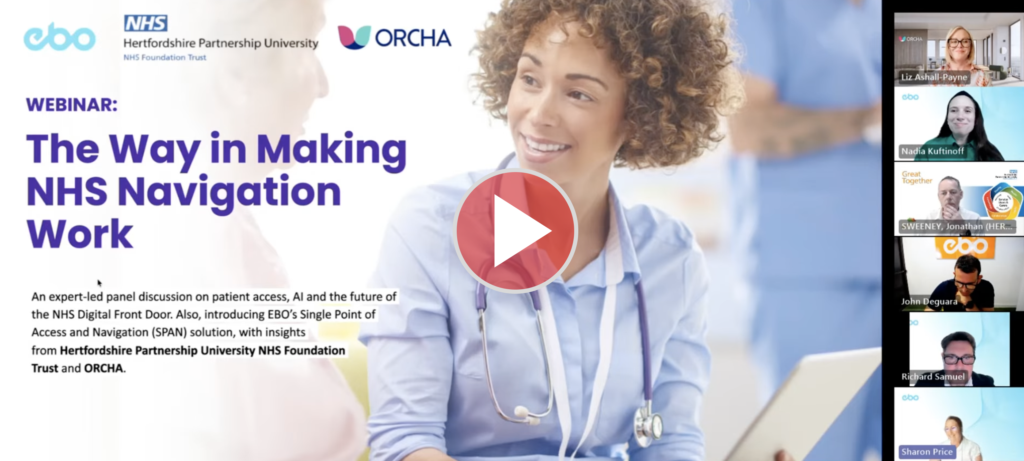
During EBO’s latest webinar, The Way In: Making NHS Navigation Work, we brought together five specialists from across the NHS to discuss the hard questions that sit beneath it. What follows are the key highlights, the questions the session explored, and the insights that are most relevant for NHS digital and transformation leaders.
Moderated by Sharon Price, EBO’s Clinical Consultant & Adoption Lead, the event featured an expert panel including:
- Richard Samuel, Director of Healthcare Strategy at EBO and former NHS England Director and Chief Executive
- Jonathan Sweeney, Head of Digital Delivery at Hertfordshire Partnership University NHS Foundation Trust
- Liz Ashall-Payne, Founder and CEO of ORCHA
- Nadia Kuftinoff, Healthcare Transformation Lead, EBO
- John Deguara, Chief Technology Officer, EBO

Key Takeaway 1
Navigation as the Connective Tissue of Neighbourhood Health
Richard reframed NHS navigation as a structural requirement of neighbourhood health, not a digital enhancement.
His core argument was that the NHS has historically focused on building multiple “front doors”, GPs, mental health services, community care, hospital access, each improving its own entry point. But from a citizen’s perspective, this has created fragmentation, not clarity.
He positioned neighbourhood health as the shift toward services organised around people’s lives rather than organisational boundaries. However, he stressed an often overlooked truth: integration at system level still fails if patients cannot navigate it.
In his view, navigation is not a layer on top of care, it is connective tissue. Without it, even well-integrated services feel fragmented in practice. He highlighted the importance of dynamic, AI-enabled tools that help citizens understand where to go, what to do next, and how to access support, without needing to understand NHS structures at all.
Key Takeaway 2
What Deploying AI Navigation Actually Looks Like at HPFT NHS
As Head of Digital Delivery at Hertfordshire Partnership University NHS Foundation Trust (HPFT), Jonathan shared the reality of deploying digital navigation in live services.
HPFT’s starting point was familiar across the NHS: multiple websites, inconsistent entry points, and service users struggling to find the right route into care. Early virtual assistants helped, but were limited by rigid Q&A structures, outdated links, and an inability to interpret intent.
The shift to AI introduced a more adaptive model, one that can understand context, improve signposting, and reduce friction in access. But Jonathan was equally clear on boundaries: this is not about diagnosis or replacing clinical judgement.
Key principles underpinning the deployment included:
- Human-in-the-loop design
- Strict reliance on trusted sources
- Clinical safety assurance (including DCB0129 alignment)
- Strong emphasis on signposting over interpretation
Key Takeaway 3
Assuring What You Signpost: The ORCHA Perspective
Liz Ashall-Payne, Founder and CEO of ORCHA, widened the lens beyond a single solution to the broader ecosystem of digital health tools being used by patients every day.
Adoption is already happening. People are using AI and digital health tools at scale, often with high trust but not always with safe or validated outcomes.
ORCHA partners with EBO to ensure that digital health technologies included in signposting have been properly assessed.
When a navigation tool signposts a patient to a digital health technology, whether for mental health support, medication management, or condition monitoring, the deploying organisation takes on a degree of responsibility for that onward journey.
She also flagged a significant gap in the current UK regulatory landscape. The MHRA has moved to a Class 1 self-certification model for AI technologies that would qualify as medical devices, meaning organisations can essentially self-declare compliance.
Liz noted that this, while well-intentioned as a way to open up the market, leaves NHS deployers in a difficult position. Knowing whether a technology you are signposting to is genuinely safe requires more than the supplier’s own assurance.
Key Takeaway 4
EBO's SPAN in Practice: A Live Demonstration
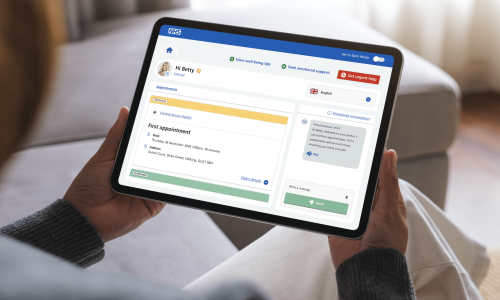
John Deguara, Chief Technology Officer at EBO, walked the session through a live demonstration of EBO’s Single Point of Access and Navigation SPAN, a digital front door built on generative AI.
Generative AI understands context across a conversation.
One of the clearest demonstrations of the difference between older NLP models and modern generative AI was the handling of follow-up questions.
When a patient asked “how can I do this online?” following a prior exchange about a self-referral pathway, the model correctly understood what “this” referred to and provided the appropriate next step, without the patient needing to restate their context. This is the kind of conversational continuity that makes a tool feel genuinely helpful rather than a frustrating loop of pre-set responses.
Curious to see how it works?
Key Takeaway 5
Designing for Adoption, Not Just Deployment
Nadia, from EBO, focused on what happens after go-live, the stage where many digital transformations succeed technically but fail operationally.
She emphasised that sustainable adoption sits across three interconnected pillars:
- Human factors (digital confidence and capability)
- Technology (usability, reliability, integration)
- Process (fit within clinical and operational pathways)
Her final point was practical but important: meaningful adoption does not happen by waiting for users to engage. It requires continuous feedback loops, real-world testing, and proactive outreach beyond digital channels.
She also stressed the importance of iterating in public conditions, using data, patient feedback, and frontline insight to refine systems over time rather than treating deployment as the endpoint.
Moving Forward
Whether you are exploring digital front door solutions for your trust, developing a neighbourhood health digital strategy, or working through the governance questions around safe AI deployment, the session offers grounded, honest insight from people doing this work in the NHS right now.
To learn more about EBO’s Single Point of Access and Navigation (SPAN), feel free to contact us. A member of our team will be happy to answer your questions and provide further information.
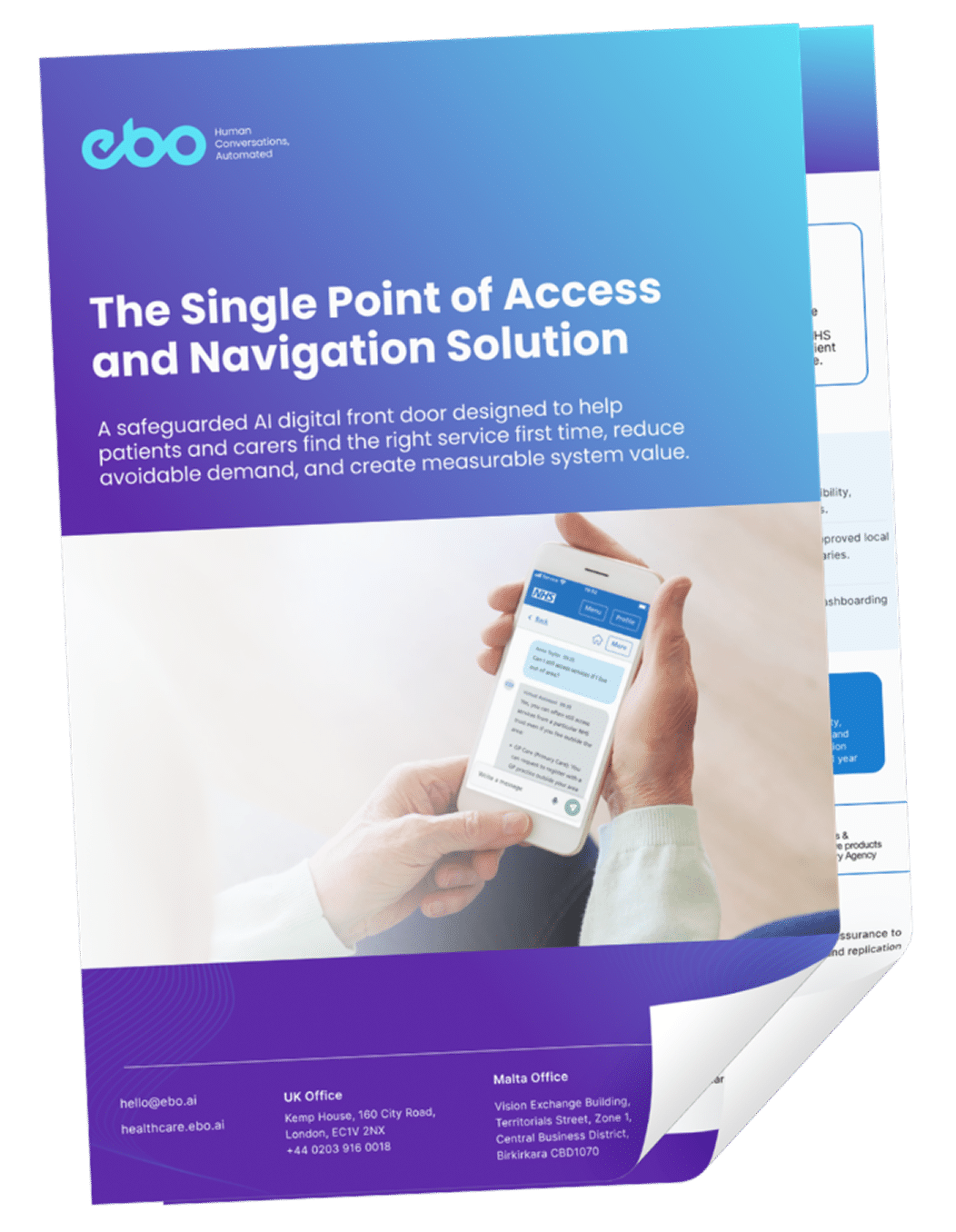
Safeguarded AI digital front door
Single Point of Access and Navigation solution
Discover how safeguarded AI supports safer, simpler, and more connected access to NHS services while keeping patients and carers at the center of every interaction.