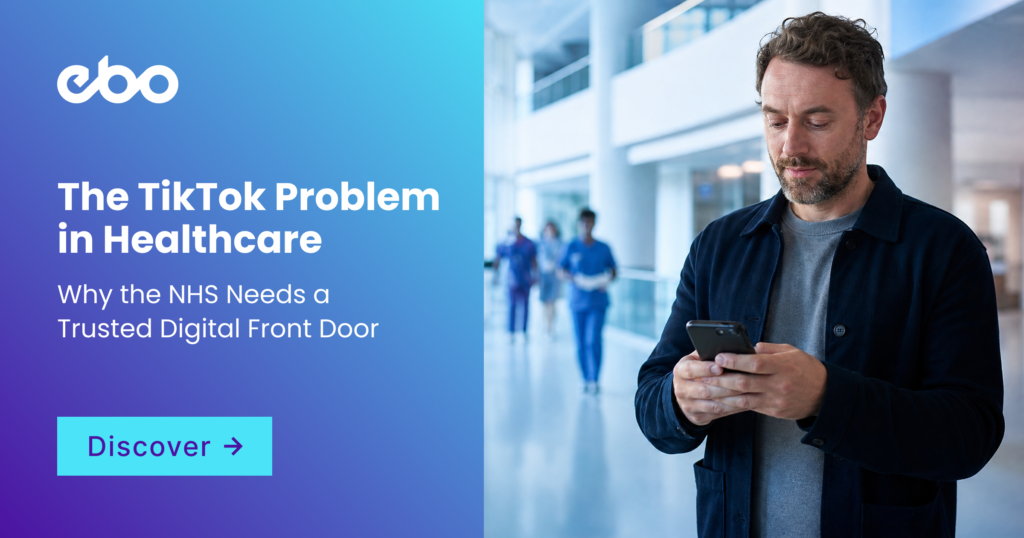
Why the NHS Needs a Trusted Digital Front Door
Where do patients go for health advice when they have a question?
Increasingly, the answer isn’t an NHS website or a healthcare professional. It’s TikTok, Instagram, Reddit, or AI-powered answer engines like ChatGPT, Gemini, and Perplexity.
People aren’t necessarily looking for entertainment. They’re looking for immediate, accessible answers. But social media algorithms prioritise engagement, not clinical accuracy. As a result, much of the health content patients see is anecdotal, decontextualised, or incorrect.
For NHS organisations, this creates a growing challenge: how do you ensure trusted, clinically approved information is easier to access than the alternatives?
Fragmentation, not information scarcity
As discussed in EBO’s recent webinar with Hertfordshire Partnership University NHS Foundation Trust (HPFT), ORCHA, and NHS digital leaders, the core issue facing healthcare systems is not a lack of information, but fragmentation of access.
Richard Samuel, EBO’s Director of Healthcare Strategy and former NHSE Chief Executive, described navigation as the “connective tissue” of modern healthcare, without which even well-designed services feel disconnected to patients.
NHS organisations have historically built multiple “front doors” across primary care, mental health, community services, and hospitals. While each may function effectively in isolation, from a patient perspective this creates confusion rather than clarity. In the context of neighbourhood health models, this challenge becomes even more pronounced.
Without a single, intelligent entry point, patients continue to experience the system as fragmented, even when services are formally integrated.

What a well designed front door should look like
Rather than expecting patients to navigate complexity, a well designed digital front door provides a single, trusted entry point into healthcare. Patients can ask questions in their own words and be guided to the right service, pathway, or support based on approved local information and clinical governance.
AI-enabled navigation can now interpret conversational intent, for example, understanding follow-up questions without requiring patients to repeat themselves, making access feel more natural and less like form-filling. It can also dynamically interpret patients enquiries and improve signposting in real time, while still operating within strict safety boundaries.
Incorporating Generative AI into a digital front door allows healthcare organisations to transform existing content from across websites, service directories and other local resources into clear, accessible, and human-centric responses.This is particularly impactful for local signposting.
Importantly, the AI does not create new service logic; it enhances access to established knowledge, making it simpler for users to understand and act upon.
AI is only valuable when it is safe, governed, and clinically assured
Generative AI has changed expectations around digital access, but in healthcare, trust is non-negotiable. AI systems must be built on approved clinical content, governed knowledge bases, and robust safety frameworks.
The webinar reinforced this through multiple perspectives, particularly around clinical safety assurance frameworks such as DCB0129, and the importance of human-in-the-loop design across all stages of deployment.
Trust cannot be added after deployment. It must be designed into the system from the start.
Governance matters beyond the technology
Liz Ashall-Payne, Founder and CEO of ORCHA, stated that digital navigation does not end at signposting. When patients are directed to digital health tools, whether for mental health support, medication management, or condition tracking, healthcare organisations inherit responsibility for that onward journey.
This raises an important governance challenge: ensuring that the tools being recommended or surfaced through digital front doors are themselves safe, validated, and appropriate for patient use.
The discussion also highlighted a shifting regulatory landscape, including MHRA approaches to AI classification and self-certification, which increases the responsibility on NHS organisations to independently assess the safety and suitability of tools within their ecosystems.
Putting this into practice with EBO’s SPAN solution
At EBO, we’ve developed SPAN (Single Point of Access and Navigation) to address exactly this challenge.
SPAN provides a single digital front door for NHS organisations, bringing together approved clinical information, local pathways, and service navigation into one conversational interface. It is designed to help patients find the right service first time, using natural language rather than complex website navigation.
Crucially, SPAN is built with clinical safety and governance at its core, ensuring responses are grounded in approved sources and aligned with NHS standards, with clear escalation routes when human input is required.
The most effective AI-powered digital front doors don’t replace healthcare professionals; they extend their reach. To learn more about EBO’s Single Point of Access and Navigation (SPAN), download our detailed guide.
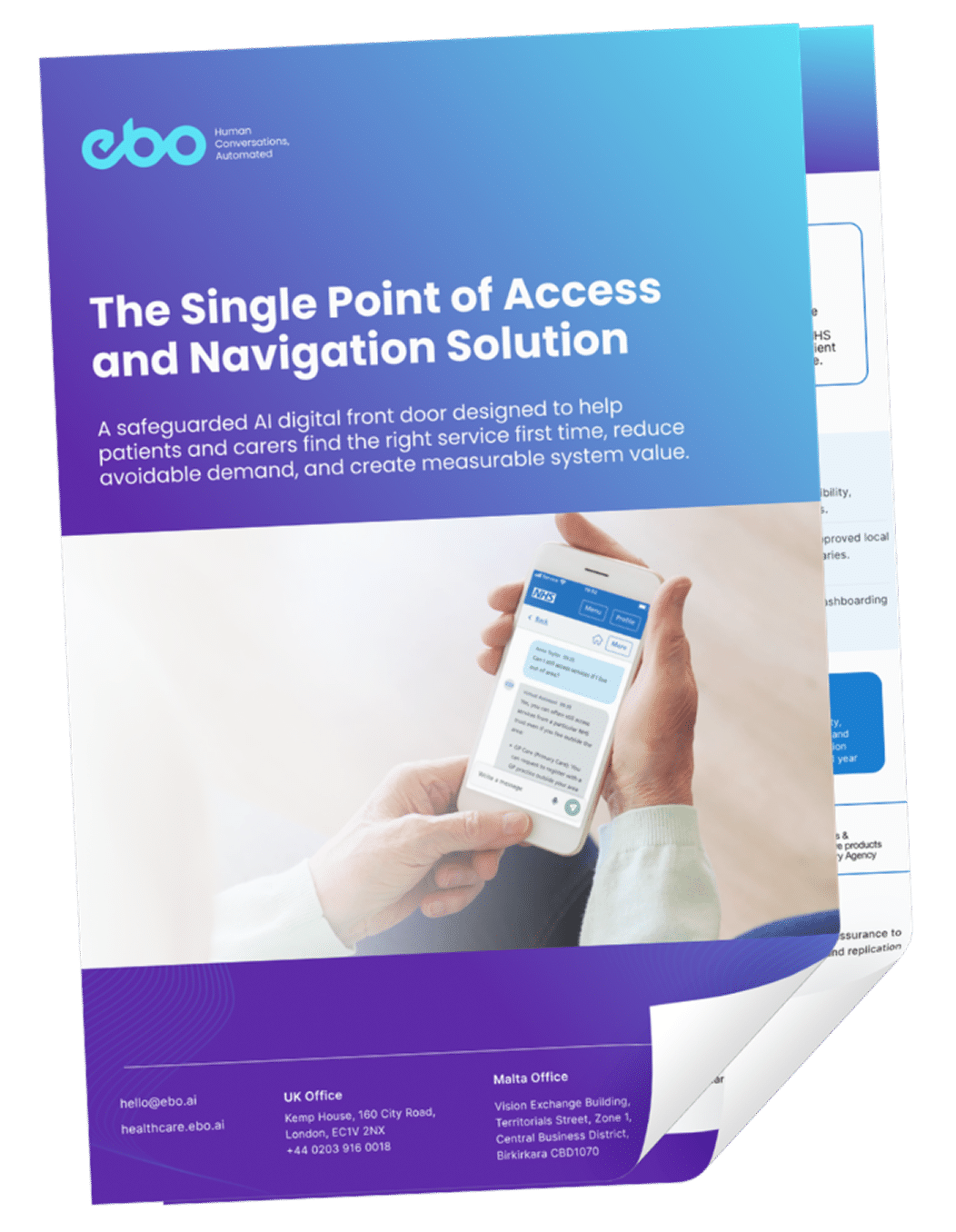
Single Point of Access and Navigation solution
Discover how safeguarded AI supports safer, simpler, and more connected access to NHS services while keeping patients and carers at the center of every interaction.