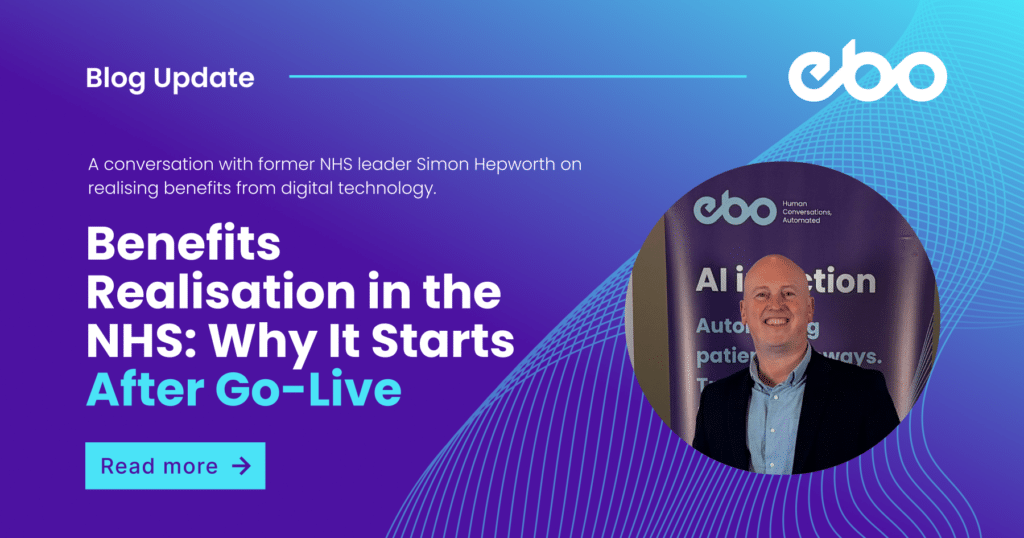
After 30 years in the NHS, Simon Hepworth, EBO’s Director of Customer Success, explains why the hardest part of digital transformation begins after go-live, and the five-part formula he uses to prove it’s working.
Simon moved from the NHS to EBO just over a year ago and now leads Customer Success as Director. We sat down with him to discuss the realities and pain points of NHS digital delivery, from patient access and digital inclusion to adoption and innovation. Here is what he shared with us.
1. You’ve recently stepped into the role of Director of Customer Success. What does the role involve, and how will your focus change?
I’m really excited to step into the role. It’s a chance to build on the work I’ve been doing with our customers and take a broader view of how we deliver real, measurable value across EBO.
My focus will move towards leading and developing our Customer Success approach. That means making sure our teams have clear ownership, the right support and the freedom to lead their accounts successfully. I’ll stay close to our customers, particularly at a strategic level, because understanding the challenges they face matters to me.
Having spent many years in the NHS, I’m passionate about making sure we don’t just deliver technology. We demonstrate the difference it makes. That means a greater focus on adoption, benefits, outcomes and long-term partnerships.
Ultimately, it’s about bringing together our people, our customers and the wider EBO team, so that Customer Success is something we can demonstrate, measure and be proud of as we grow.

2. It’s been just over a year since you moved from the NHS to EBO. What has surprised you most about working on the supplier side?
Probably the speed at which we can work and make things happen. But actually, it’s more than that.
I’ve been struck by the dedication across the whole EBO team to delivering something that genuinely supports patient care.
I know phrases like “putting patients at the heart of what we do” are used a lot, particularly in healthcare, but in this case I really mean it. There is a real sense across EBO that people understand the value of what we’re delivering and the difference it can make for patients.
That shared sense of purpose has given me some of the warmth and connection to patient care that I valued throughout my time in the NHS.
But working on the supplier side has also given me a different kind of freedom, the freedom to move quickly, develop ideas and find new ways of solving problems for our NHS customers.
I think it’s that combination of purpose and pace that has surprised me most.
3. Can you share an example from the past year where feedback from NHS staff or patients changed how a solution was delivered?
It’s hard for me to choose just one example, because listening to NHS staff and patients is built into how we work at EBO.
We’re constantly talking to our customers, listening to their experiences, testing what works and then adapting and improving what we deliver.
For me, that’s really important. We shouldn’t develop technology in a bubble based on what we think people need.
We need to listen to the people using it and understand what works for them in the real world.
That continuous feedback is how our solutions evolve. We ask, we listen and we adapt and ultimately make sure that what we’re delivering genuinely supports our NHS customers and their patients.
4. From your perspective today, which challenges around patient access, digital inclusion and connected services are proving hardest to solve?
Having spent more than 30 years working in the NHS, and now at EBO, I have the benefit of seeing digital transformation from both sides, as someone who understands the realities of delivering NHS services and now as someone working with NHS organisations to help technology deliver meaningful outcomes.
One of the biggest challenges I see is ensuring we start with the problem we are trying to solve, rather than starting with the technology.
Healthcare is incredibly complex. A solution can look impressive in a presentation, but the real test comes when it meets the operational reality of the NHS. Does it integrate with existing systems and pathways? Does it make things easier for staff? Does it improve access for patients? And, importantly, will patients and staff use it?
From a Customer Success perspective, that means our job doesn’t end when technology is implemented or goes live. We need to work with NHS organisations to understand the outcomes they are trying to achieve, support adoption and pathway change, measure the benefits and continually optimise the solution.
Digital inclusion is a particularly important part of this. Digital transformation cannot simply mean taking an existing process and putting it online.
Connected services are equally important. Patients don’t experience healthcare as individual systems or organisations, so technology needs to connect pathways, information and services in a way that makes the experience simpler for them and for the staff providing their care.
For me, the hardest challenge isn’t finding more technology. The NHS already has a significant amount of technology. The challenge is choosing and connecting the right technology to solve the right problems, achieving meaningful adoption, and then demonstrating that it has genuinely improved outcomes for patients, staff, and NHS organisations.
5. Last year you told NHS leaders to embrace innovation while staying focused on value. Would you say the same today?
My thinking has changed slightly. I still believe the NHS needs to embrace innovation and stay focused on value, but I think I now have a more considered view of what needs to sit around that innovation for it to succeed.
The NHS absolutely needs to use technology to improve how we support patients, but the technology we adopt needs to be interoperable and integrated with the systems and services already in place. If it isn’t, there’s a real risk that we simply add another layer of technology and, ultimately, another layer of complexity for staff and patients.
Two of the biggest challenges for NHS providers are resource and understanding:
- Resource: the right people to deliver the technology and, importantly, to support the transformation around it.
- Understanding: a clear picture of what is being procured, and confidence that it will deliver the automation, integration and outcomes expected.
So my advice today would be: embrace innovation, but make sure it’s the right innovation. Focus on technology that can integrate, automate and deliver measurable value for patients and for the staff providing their care.
6. How do you measure customer success in a way that reflects what matters to patients, staff and NHS leaders?
For me, there’s a simple formula:
Relationship + Understanding + Transformation + Adoption + Measurable Outcomes = Customer Success
- Relationship. You need strong relationships at both senior and operational level. Without trust, you don’t get the conversations that tell you what is really happening in an organisation.
- Understanding. Every NHS organisation, service and patient population is different. We need to understand the problem they’re solving, the pressures staff face and what “better” looks like for their patients.
- Transformation. Understanding isn’t enough. Simply deploying a solution doesn’t automatically change a service. We work alongside NHS teams to redesign processes and make sure the technology becomes part of how the service operates.
- Adoption. For me, this is fundamental. You can deliver the best technology in the world, but if patients and staff don’t use it, you haven’t delivered the value you set out to achieve.
- Measurable outcomes. Finally, we need evidence:
⇒ Has access improved?
⇒ Are patients having a better experience?
⇒ Have we released staff time?⇒ Has adoption increased?
⇒ Are we delivering operational or financial benefits?
Realising the full value of technology starts long before go-live. It starts with asking the right questions at the point of procurement, including whether a tool is clinically safe, compliant and ready for real-world use.
To support NHS leaders, CSOs and digital teams do exactly that, we’ve created a practical guide to DCB0129, DCB0160, DTAC, DPIAs and clinical-safety best practice.
👉 Download the Healthcare Guide: A Practical Framework for Safe AI Deployment.
Your Guide to AI in Healthcare
- Redefine Patient Engagement
- Build Meaningful Relationships
- Enhance Patient Access